










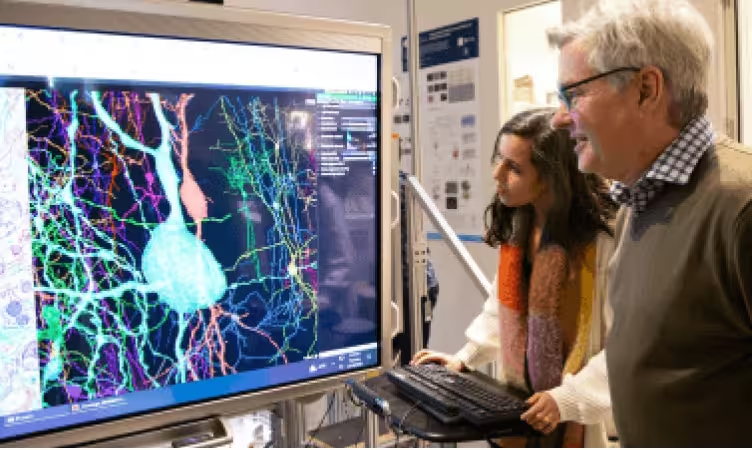
The MICrONS Project set out to create a massively dense reconstruction of the structural connections and functions of an entire millimeter volume of mouse visual cortex, along with new artificial intelligence-driven tools.
Our Research
Focus Areas
Focus Areas
Learn more about the scientific discplines studied at the Allen Institute for Brain Science.
Anatomy Atlases
Among our most widely cited resources, these neuroanatomical atlases provide data-driven, high-resolution maps of the mammalian brain.

Adult Mouse
These anatomical reference atlases illustrate the adult mouse brain in coronal and sagittal planes of section.
Adult Human
These anatomical reference atlases illustrate the adult human brain, using modified Brodmann or gyral annotation.
Developing Mouse
These anatomical reference atlases illustrate the developing mouse brain, covering seven stages of embryonic and postnatal development.
Developing Human
These anatomical reference atlases illustrate the developing human brain, covering two embryonic stages.
Mouse Spinal Cord
These anatomical reference atlases illustrate the mouse spinal cord in adult and juvenile C57BL/6J mouse.
By examining brain cell types and connections across species at a refined level and at the most comprehensive scale – we are working towards understanding the structure and function of the human brain itself.

Hongkui Zeng, Ph.D.
Executive Vice President, Director of the Allen Institute for Brain Science
Our Open Science Philosophy
We share what we do openly with the world
We believe shared understanding accelerates new discoveries and nurtures breakthroughs. The Allen Institute openly shares datasets, software, protocols, lesson plans, modeling tools, machine learning algorithms, cell lines, plasmids – and more – to accelerate bioscience research and discovery worldwide.
Featured Publications
Defining and characterizing the underlying gene expression, gene regulatory, and morphoelectric features of cell types in the human and non-human primate (NHP) brain.
Generating a complete multimodal cell census and atlas of the mouse brain through collaborative data collection, tool development and analysis.


Visualize
650 terabytes
of high-resolution 3D imaging data

Analyze
700 billion
gene expression data points in the mamillian brain

Contribute
350,000
neuroscientists around the world interacting with our data annually
Open Science Impact
The Allen Institute openly shared datasets, software, protocols, lesson plans, modeling tools, machine learning algorithms, cell lines, plasmids - and more - to accelerate bioscience research and discovery worldwide.


Allen Institute cell types in CZ Cell x Gene
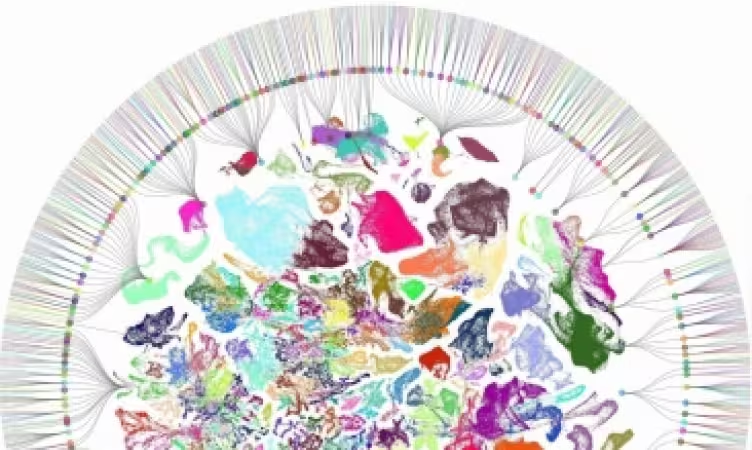
Based on ~1.4 million cells in middle temporal gyrus, the Seattle Alzheimer’s Disease Brain Cell Atlas (SEA-AD) atlas includes 139 transcriptomically distinct supertypes well conserved across aged donors and neocortical areas.
The ABC Atlas highlights the spatial localization of each cell type in donors with and without AD by visualizing these data alongside a complementary MERFISH data set profiling ~300 thousand cells.
CZ Cell x Gene further highlights genes associated with different cell types and disease states, allowing both scientists and students to ask specific questions about the molecular underpinnings of age and Alzheimer’s disease.

Research Support
Tutorials, how-to guides, docs, and more
Access a broad range of use case centered tutorial & how-to resources, tool centered documentation, and get direct support from Allen Institute staff in the community forums.
Science Programs at Allen Institute
One Institution
Many Endeavors
Many Endeavors
The mission of the Allen Institute is to understand the principles that govern life, and to advance health. Our creative and multi-dimensional teams focus on answering some of the biggest questions in bioscience.
Learn more on alleninstitute.org.